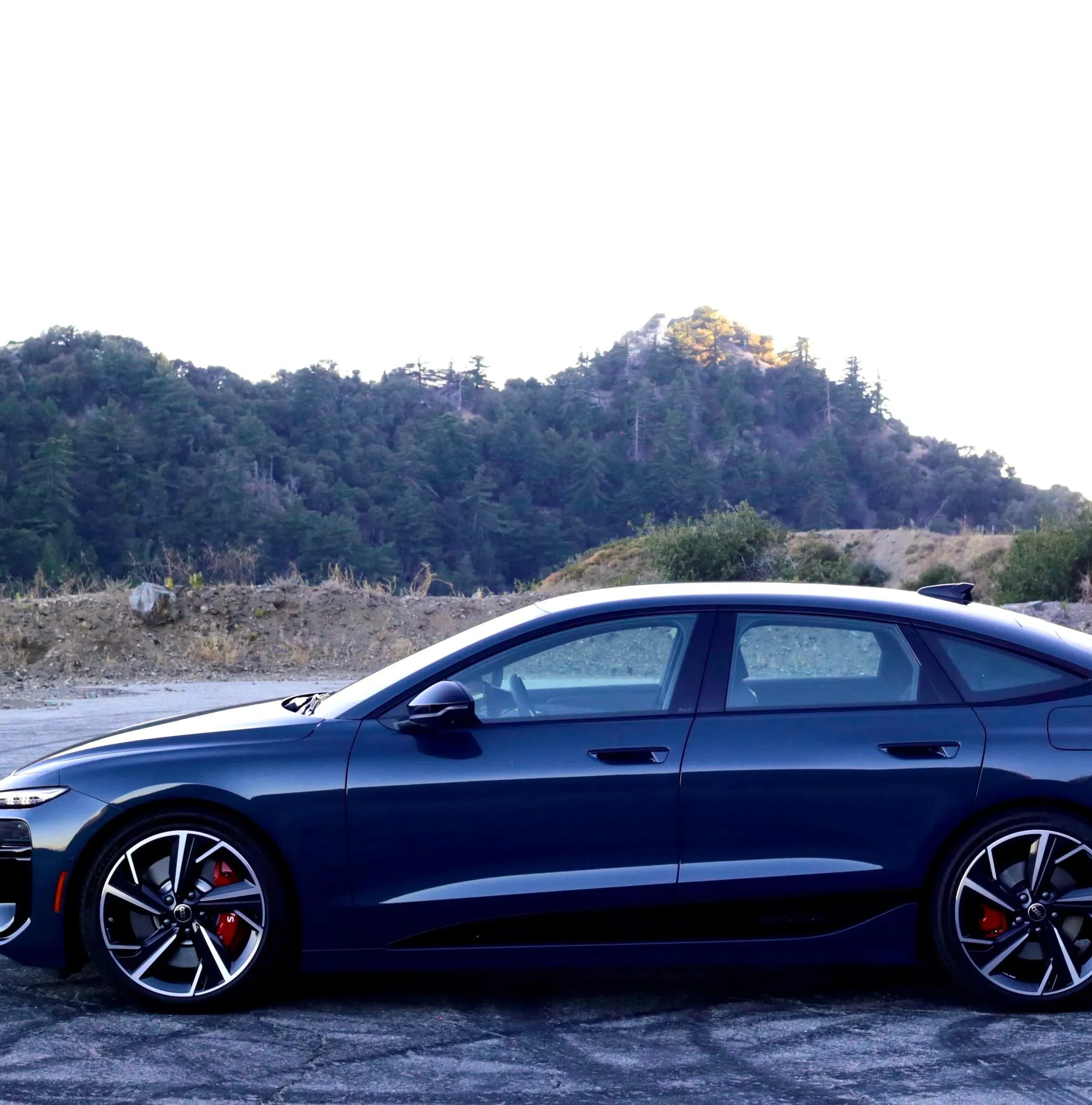

Worth considering if you want one EV to cover a quiet commute, long highway days, and entertaining weekend roads. The 2027 Audi S6 Sportback E-tron charges quickly, rides comfortably, and opens a large hatch, but its real-world efficiency fell below the headline range figure and the sloping roof limits rear-seat space. Audi’s U.S. specifications and an independent Car and Driver test make the decision clearer. Updated August 20, 2026.
Buy it if fast charging and balanced performance matter more than maximum rear-seat room. Skip it if you regularly carry tall adults or expect the EPA number to describe every road trip.
1. The useful range starts below the window sticker
Audi gives the S6 an 800-volt architecture. In simple terms, that electrical system can accept high charging power at compatible public stations. The battery is listed as a 100 kWh pack with 94.4 kWh net in the hands-on review, while Audi’s technical data lists 100 kWh gross and 94.9 kWh usable. That difference matters when comparing published specifications, so buyers should check the equipment-specific window sticker.
The source review cited a 326-mile peak rated range. Current Audi U.S. data lists an EPA-estimated range of up to 324 miles when the car wears 20-inch wheels. The EPA, or Environmental Protection Agency, figure is a standardized comparison point, not a promise for winter, high-speed travel, or a fully loaded cabin.
An independent test covered 295 miles at an average of 2.4 miles per kWh and an average speed of 19 mph. The route mixed city driving in the Los Angeles basin with highway and mountain-road sections. The report did not specify temperature, precipitation, passenger or cargo load, climate settings, tire pressure, starting state of charge, ending state of charge, or charging events. That means the test shows observed efficiency over a particular drive, not a controlled full-charge range result.
For your life, the decision is simple: use the EPA figure for broad comparison, then plan around less on trips that involve cold weather, high speeds, or steep roads. Plan for the trip, not the brochure.
2. Charging reduces travel friction, with one catch
Audi quotes 10 to 80 percent charging in about 21 minutes on a suitable public DC fast charger. DC means direct current. It sends electricity to the battery at much higher power than home charging. The S6’s peak is rated at 270 kW, and the hands-on review observed that number at an Electrify America station, followed by 194 kW during another visit.
That observed result supports the car’s long-trip promise, but peak power is not the same as a constant rate. Charging normally slows as the battery fills, which is why Audi’s 10-to-80-percent figure is more useful than a claim based on an empty-to-full session. The exact time still depends on the charger, battery temperature, station performance, and how much energy the car accepts before charging slows.
At home, a 240-volt Level 2 setup delivering 9.6 kW takes about 11.5 hours, according to the source material. Level 2 is the faster type of home charging that uses a 240-volt connection. That timing fits an overnight routine. Public charging becomes more important for apartment residents and anyone who cannot install a 240-volt connection. U.S. cars use the CCS, or SAE Combo, inlet as standard. Audi owners can access NACS, the connector used by Tesla and an expanding number of chargers, through an adapter or option.
The practical upside is a useful break rather than a long appointment. The trade-off is network planning. Choose it if you can charge at home or near work, and confirm the public stations along your regular weekend routes before paying luxury-car money.
3. Performance serves the commute, then rewards the detour
The S6 sends power through one motor on each axle and produces 543 hp with launch control. Audi lists 3.7 seconds from 0 to 60 mph. Car and Driver measured about 3.4 seconds in its independent instrumented test, showing that the factory figure leaves some room for a prepared launch.
The number is only half the story. The power delivery builds progressively, so the car does not demand constant restraint in normal traffic. The source tester found the steering light in town but more weighted at highway speed. Its 16.4:1 steering ratio suits the car’s size, and the S6 stayed settled during quick lane changes.
On freeways, the heavy electric Sportback used its mass to feel planted, while wind noise stayed nearly absent. On winding roads, rear-biased power and well-controlled body movement reduced the understeer that can make a large performance sedan feel reluctant to turn. Sport-tuned air suspension offered Comfort, Dynamic, and Dynamic Plus settings. All three dealt with rough pavement and speed bumps without turning the cabin harsh.
Three regenerative-braking levels let you choose how strongly the car slows when you lift off the accelerator. Two settings use the steering-wheel paddles, while B mode provides full one-pedal driving. The review found each setting smooth in daily use. That makes the S6 easier to place in traffic than its acceleration figure suggests. Quick when asked, calm when not.
4. The hatch helps, but the roof collects its payment
The Sportback shape gives the S6 a wide opening that makes loading easier than a conventional sedan’s trunk. Cargo space starts at 26 cubic feet and expands to 39 cubic feet. That is enough to make airport bags, groceries, or weekend equipment less awkward, and the hatch lets you lift bulky items straight in.
Rear passengers face the obvious compromise. The sloping roofline can leave taller adults feeling squeezed, even though the front seats and driving position earned strong marks in the review. If your normal trips involve two people, the shape pays off in cargo access and a lower visual profile. If three adults regularly share the back seat, test that fit before signing anything.
Standard equipment includes 20-inch wheels with all-season tires. The reviewed car used the $2,000 Black Optic package with 21-inch wheels and Michelin summer tires. Those larger, stickier tires helped the car grip but may reduce range from Audi’s rated figure. The ride still handled broken pavement well, although the low front bumper could scrape on steep driveways.
Pricing starts at $80,895 USD in the source review, while Audi U.S. lists a starting MSRP of $79,600. Confirm the current configuration and destination charges before comparing it with rivals. The BMW i5 M60 offers a useful alternative: the source comparison gave it 50 more horsepower, a similar 0-to-60 time, about 45 fewer miles of range, and a price a few thousand dollars higher. The Audi’s case rests less on one winning statistic than on how smoothly its comfort, hatchback practicality, charging, and handling work together.
- Choose the Audi for fast public charging, composed highway behavior, and a large cargo opening.
- Compare the BMW i5 M60 if extra power matters more than rated range.
- Look elsewhere if rear-seat headroom or maximum winter range controls the purchase.
- Check the charger route before ordering, especially if home charging is unavailable.
The S6 also arrives as Audi rethinks its previous all-EV-by-2033 plan and continues offering gasoline, hybrid, and electric vehicles. That broader strategy does not change how this car drives, but it does make a current purchase easier to frame: you are choosing a well-developed electric luxury sedan, not betting your routine on a future lineup.
Final verdict: worth a test drive when your daily life can support home or reliable public charging and your passengers do not need generous rear headroom. Before you buy, drive the route you actually use, check the fast chargers you would rely on, and sit in the back seat with the people who will ride there. If those checks pass, the S6 can make weekday travel quieter and weekend roads more interesting without asking you to give up a usable hatchback.